
The Life and Times of Pierre Marly (1793–1839)
Illustrious journey of a neighborhood namesake
PART IV: Marly makes his move, a vision realized
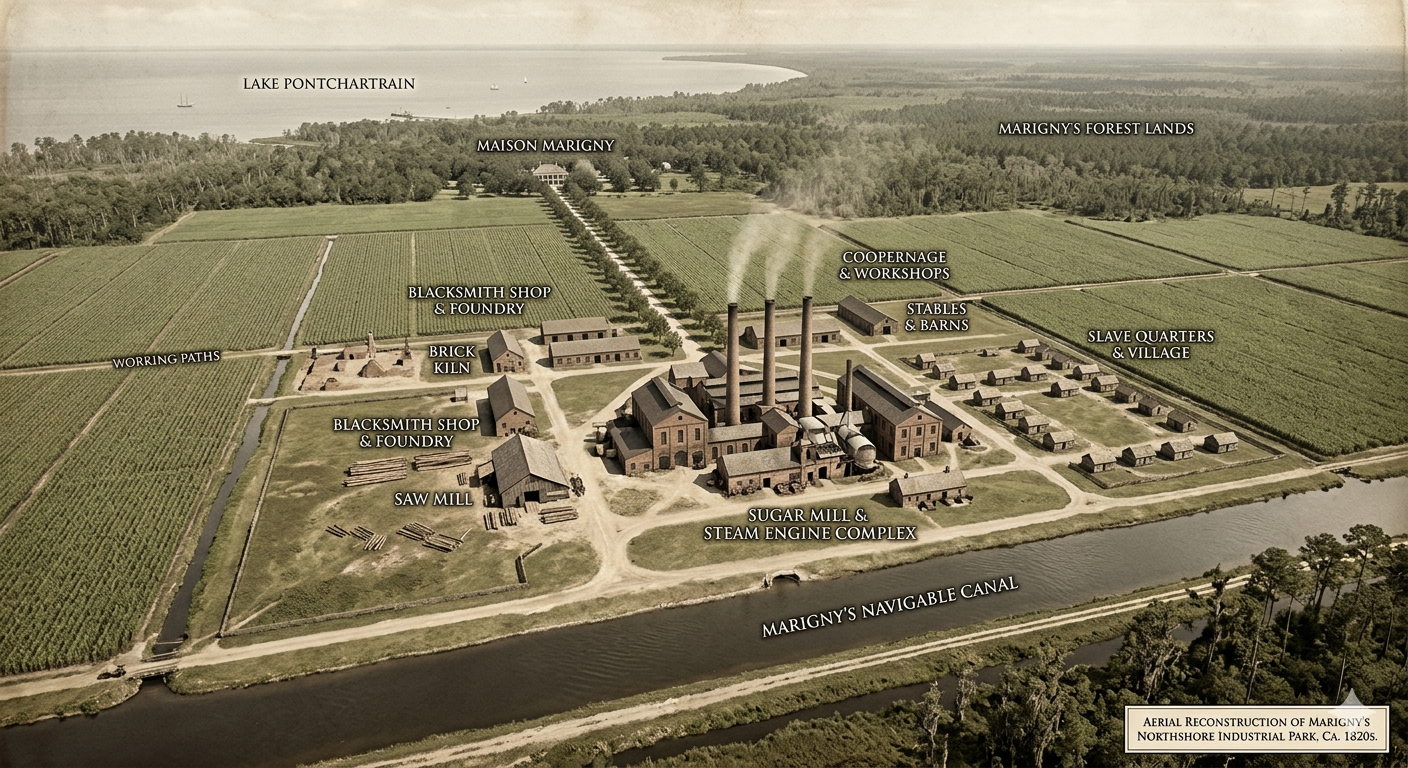
Fontainebleau Plantation and Bernard Marigny’s industrial park on Lake Pontchartrain (1829)
The Marly family had lately taken up residence at the corner of Union (Touro) and Girod (Villere) Streets, in the heart of Faubourg Marigny, a popular new neighborhood for young families desirous of a safe, suburban lifestyle with the convenience of close proximity to the French Quarter. The suburb’s founder, Bernard Marigny—an inveterate gambler possessed of lofty ambition and easily the most prolific landholder of his day, with political connections at every level of government—was an immensely wealthy Creole aristocrat whose business acumen Marly hoped to imitate. Marigny’s ventures included the establishment of Mandeville, a popular retreat on the north shore of Lake Pontchartrain, a short distance from his grand Fontainebleau plantation, sugar mill and brick kiln.
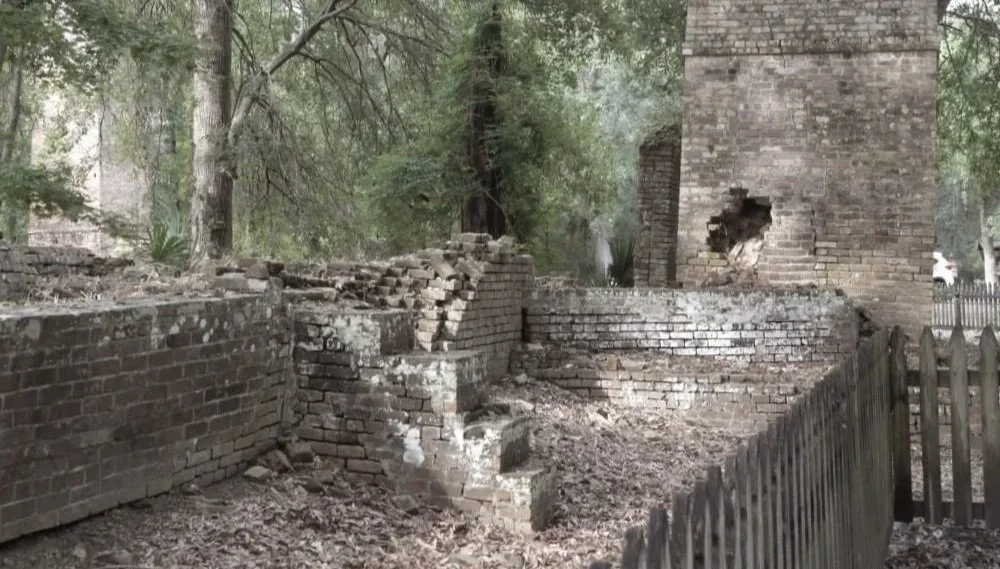
Present-day ruins of the Marigny sugar processing mill at Fontainebleau
Following the Battle of New Orleans, like so many of their brothers in arms, the two industrious men remained in contact on matters both personal and business-related, routinely crossing paths at notarial offices around town. Marigny confided that he had recently acquired a half interest in his brother-in-law’s 1600-acre sugarcane plantation several miles upriver from New Orleans, and was actively engaged in negotiations to secure the remainder in partnership with one of his cousins, the prominent Irish cotton planter Maunsel White. Their $130,000 real estate investment—reserved for a planned resort community known as Carrollton—expanded an already-sizable portfolio of state land grants extending to Old Spanish Fort, being assembled by a cohort of elite developers: financier Samuel Kohn, railroad tycoon Laurent Millaudon, political strategist John Slidell, and port administrator Beverly Chew, among others. Meanwhile, the same board negotiated the laying of a new commuter rail line connecting Carrollton to downtown New Orleans via Cours des Nyades (St. Charles Avenue) and Tivoli (later Lee) Circle, aimed at replicating the popular and highly profitable Pontchartrain Railroad operating across town in Faubourg Marigny.
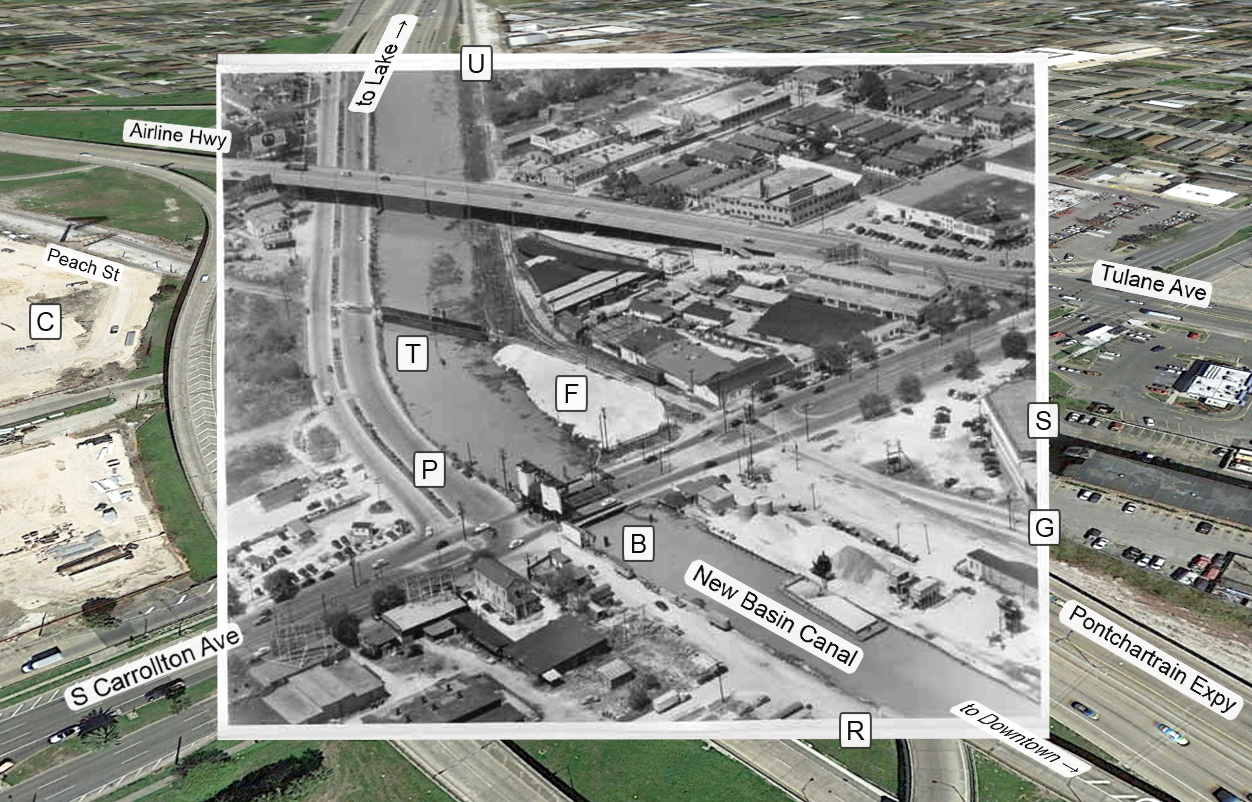
Aerial view of New Basin Canal and shell road at the Carrollton Avenue bridge crossing (circa 1950)
The charter of Canal & Banking Company, an improvement bank headed by White, authorized digging a navigation canal that connected Faubourg Sainte Marie (the American Sector known today as the Central Business District) with Lake Pontchartrain, along the parish border. New Basin Canal, being significantly deeper and wider than the aging Carondelet Canal—not to mention straighter than Bayou St. John—permitted larger seagoing vessels to pass and turn around with ease; crucially, its West End wharves accommodated a vastly greater volume of goods destined for Marigny’s industrial park at Fontainebleau. Atop the canal’s left bank, the forward-thinking Company laid out a broad shell road suitable for pedestrians, carriages and barge-towing mules, with a swing bridge placed approximately midway, at its crossing with Carrollton’s central thoroughfare.
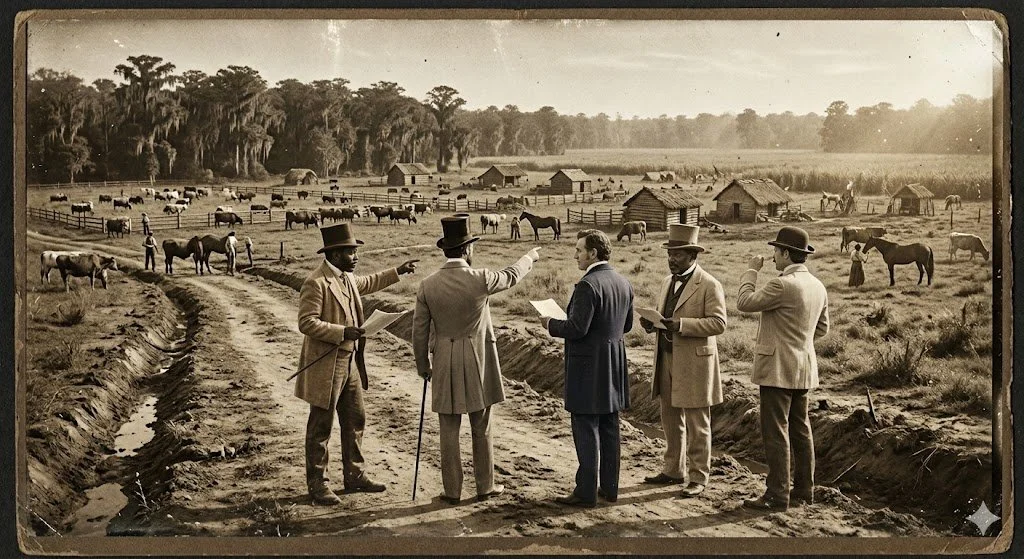
Marly, Marigny, White, Macarty and Kohn surveying the rearmost section of Macarty’s property (1833)
Marly instantly saw tremendous future commercial value in the proposed waterway, the tow path road and, of course, the coming New Orleans & Carrollton Railroad, expected to terminate at a grand hotel less than a mile from New Basin Canal. On the occasion of his 40th birthday in 1833, Pierre approached the Company board with a proposition, offering to purchase from them—at a modest wholesale discount and financed largely on credit, by signing a customary bond for deed—the excess 80-acre allotment just outside the Carrollton footprint. With ample waterfront access, Marly reckoned, this heavily wooded, swampy tract offered maximal development potential with relatively low risk.
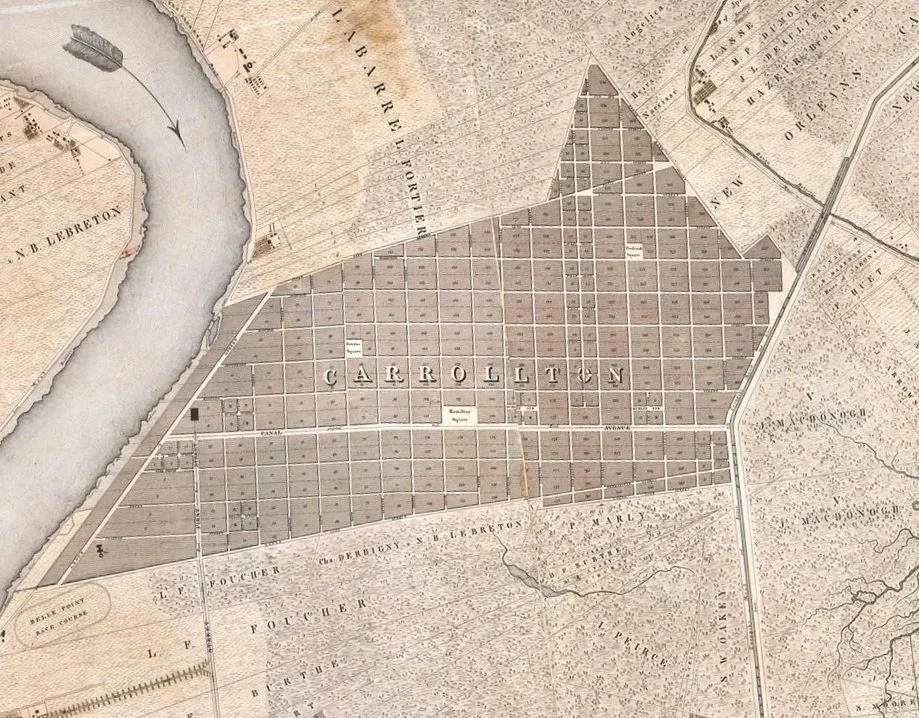
Property acquired by Pierre Marly (right of center) just below the Town of Carrollton (1833)
To begin with, as the property was cleared, he could sell felled cypress timber to builders, thereby generating revenue to pay his creditors. Then, once drained, the exposed area could be further subdivided into smaller affordable lots, making them attractive to the many artisans, craftsmen and laborers needed to support a new suburb, the very approach pioneered in the 1820s by his mentor Marigny. In this way, Marly the businessman foresaw admirable returns for his efforts; but more importantly, Marly the proud visionary—free to plat the avenues of Faubourg Marly as he saw fit, forging his namesake mecca from seeming nothingness—could finally cement a lasting legacy for his family.
The gentlemen settled on a $16,000 purchase price and drafted the mortgage papers, which Pierre Marly dutifully signed at notary Louis T. Caire’s office on Royal Street the morning of Tuesday, June 4, 1833, setting in motion his ultimate dream.
