
Citizen’s Guide to NOPD
Introduction and Purpose
Whether you’re a veteran researcher, a news reporter, or a neighbor just looking to stay informed, I’ve designed this Citizen’s Guide to NOPD with you in mind. I know that navigating the complexities of the New Orleans Police Department can feel daunting, so my goal is to provide a clear and comprehensive, yet accessible starting point for people curious about their mission.
For prospective recruits wanting to join the force, concerned citizens attending their first public meeting or tracking local crime trends—indeed anyone eager to learn the finer points of police work—I hope this Guide provides the road map you need. I’ve also included most of the resources mentioned below on this site’s “Links” page for quick reference.
Communications and Meetings
One of the best ways to stay informed is to step inside the conversation, whether that’s in person or online. The NOPD regularly holds quite a few public meetings, giving you ample opportunity to interact with district leadership:
Weekly District MAX meetings are open to the public and available online
Weekly HQ MAX meetings at police headquarters may be closed to the public
Monthly District NONPACC meetings are open to the public and include Q&A
Police Community Advisory Boards (PCAB) meet quarterly within each district
Some meetings are held virtually over Zoom and archived on NOPD YouTube
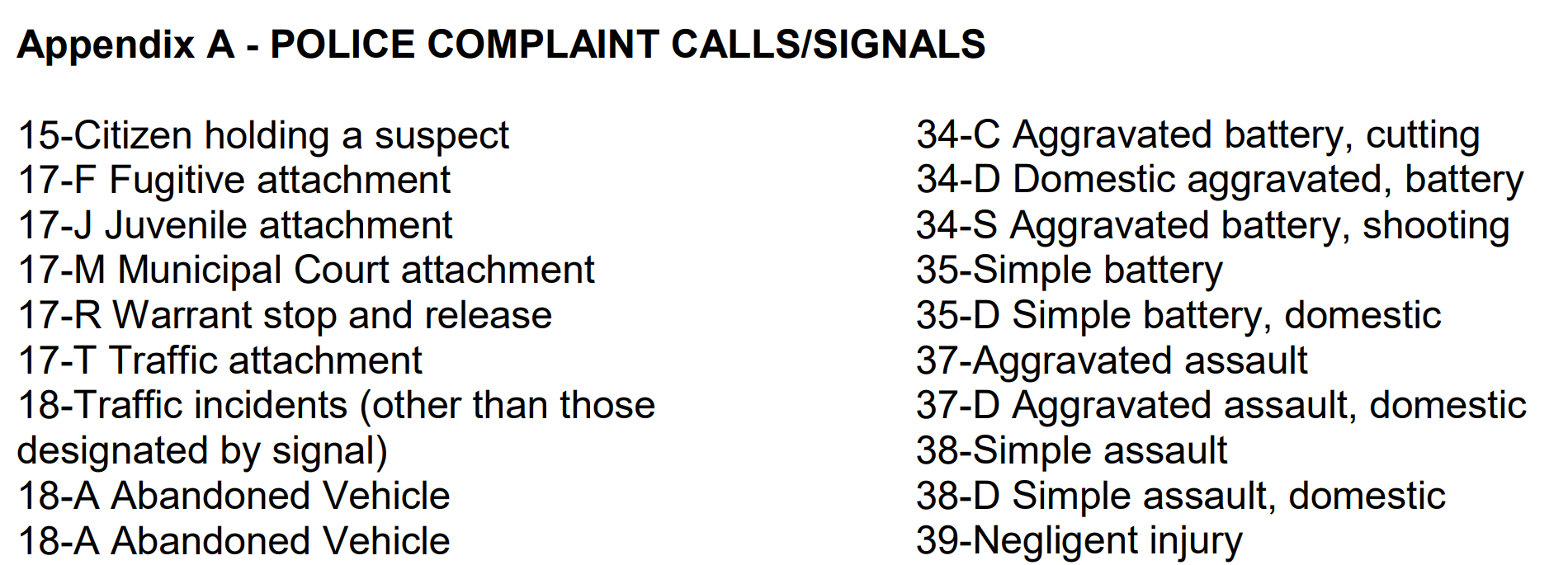
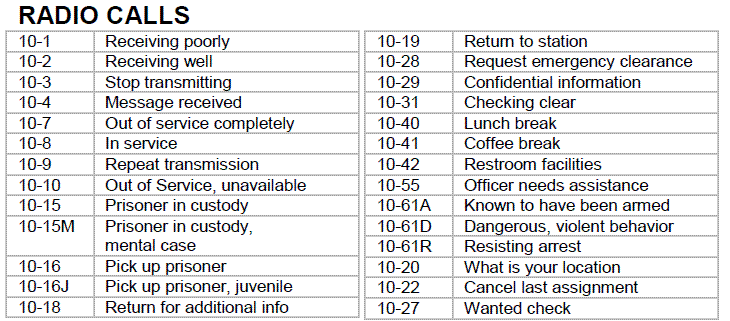
If you ever feel lost while listening to police reports, either in person or over dispatch radio, don't worry; there are several excellent online resources for decoding police codes and signals, even sets of NOPD-specific flashcards, that help you make sense of the chatter. Eventually, you will learn to translate the cryptic-sounding “62-C” to a more familiar “simple auto burglary”, and understand the officer’s “10-18” response means “request for additional information.”
Deciphering the Codes
Examples of police jargon that civilians may encounter during NOPD meetings
For day-to-day updates, the department stays surprisingly active on social media. Each of the eight districts maintains a Facebook page, which you can follow for fastest delivery of crime alerts or community events and photos specific to your neck of the woods. Likewise, NOPD headquarters broadcasts urgent advisories and press releases over its Twitter feed, NOPDNews, through the Public Information Office (PIO). For more formal items, like official policies or departmental reports, you can always consult the dedicated NOPD pages of City Hall’s website, which include a non-emergency tip line and a form for requesting copies of incident reports.
You can obtain additional community safety information from outside agencies like OffenderWatch, publishing updates to the sex offender registry, or check inmate status through the Orleans Parish Sheriff’s Office website. Police scanner enthusiasts enjoy listening to various live audio feeds, for real-time dispatch activity over the Internet, although encrypted channels are typically unavailable for public consumption.
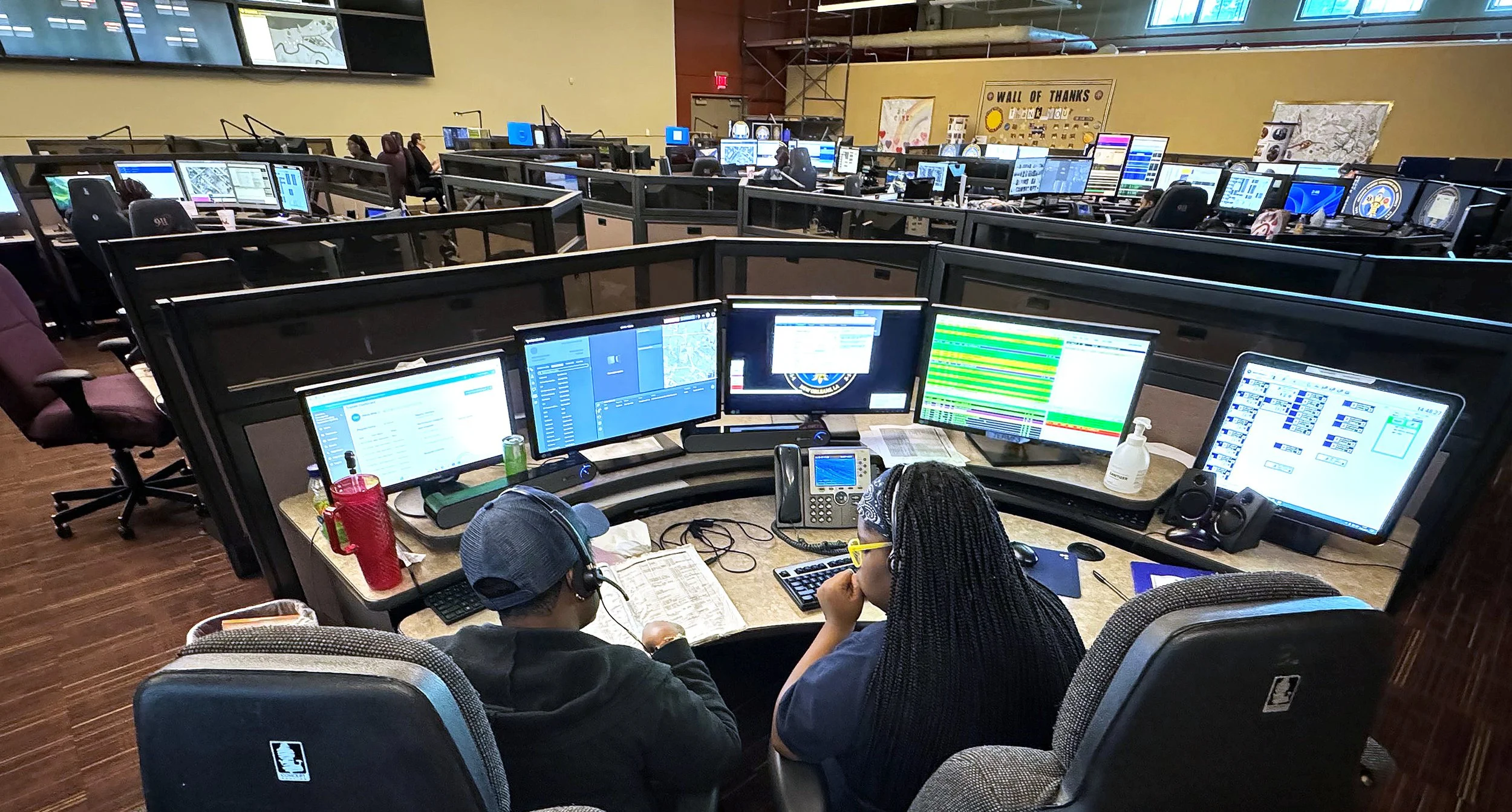
Speaking of communications, NOPD has always been tightly integrated with the City’s 911 call center at Orleans Parish Communications District (OPCD), where operators act as the vital first link and often a literal lifeline in emergency situations. During major events and natural disasters, NOPD coordinates activities with Office of Homeland Security & Emergency Preparedness (NOHSEP) and Louisiana State Police, while NOLA Ready provides timely updates to subscribers like you closer to home.
Data Reporting and Statistics
This is where things get a bit more technical, so let’s follow how raw crime data turns into the official numbers we see in the news, with an eye towards how they inform NOPD’s decision-making process. Every day, the department collects and responds to information from multiple sources: 911 calls, accident scenes, investigations, crime cameras, anonymous tips, field interviews and officer-initiated stops, university campus police logs. That information is captured in real time, reviewed for classification accuracy, analyzed to spot trends, and summarized for reporting purposes.
The data first passes through Management Analytics for eXcellence (MAX), software that goes beyond its predecessor (COMSTAT) by examining a wider range of performance indicators, such as risk assessment and response times. It is then shared with patrol officers or detectives working the case, and discussed during closed-door departmental meetings, then added to the NOPD crime map. At weekly district MAX meetings, you can request a copy of the prior week’s statistics as a handout or by email. A separate tally is kept of which cases are eventually cleared (solved), either by arrest or exceptional means, another important metric.
City’s NOPD Data Depot
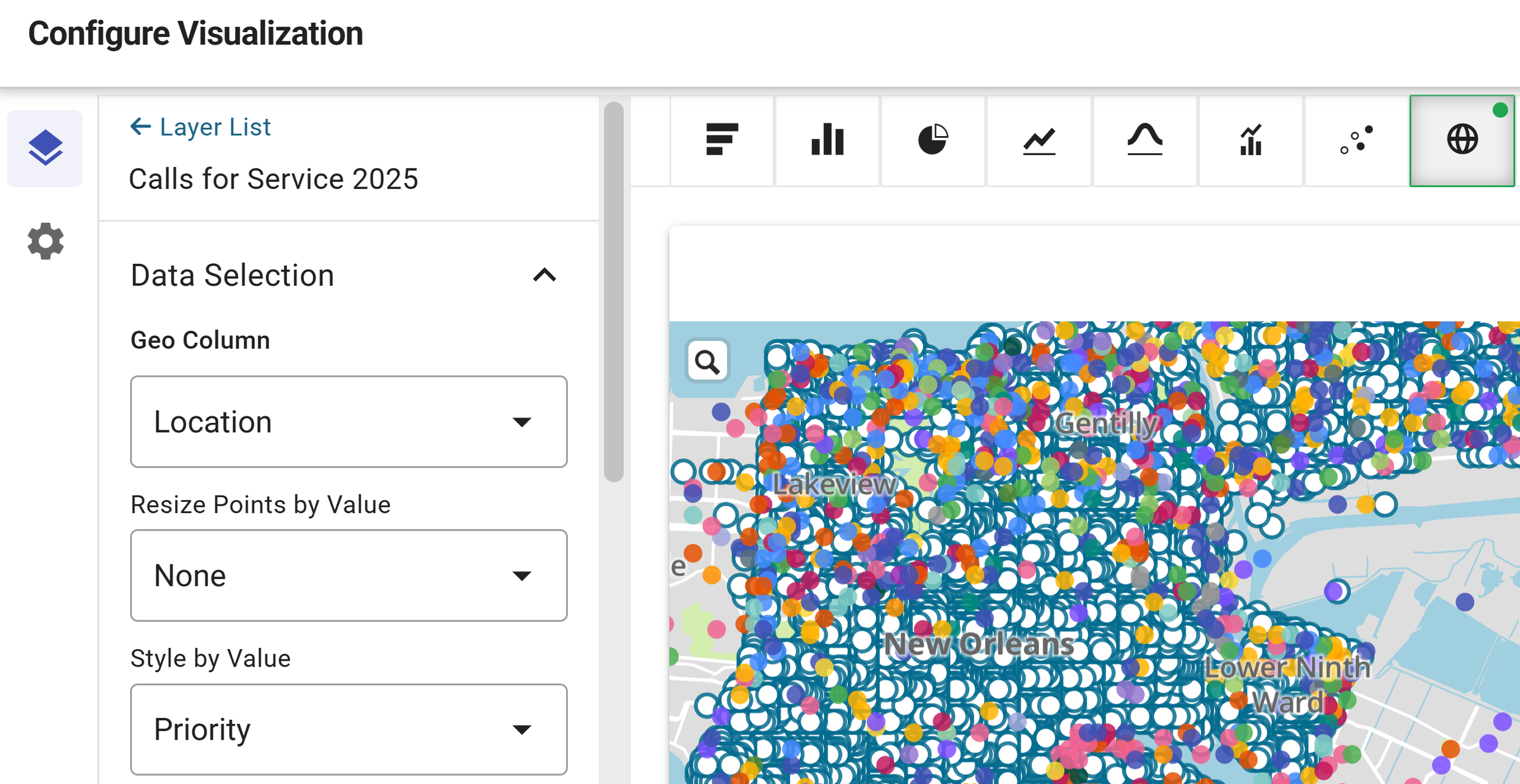
Visualizing crime data is easy with the mapping and charting tools available at data.nola.gov
Next, the city’s data.nola.gov website compiles the historical crime data, allowing calls for service to be mapped (as illustrated above) or listed by type, district, or time of occurrence. This publicly accessible repository gives you a transparent look at exactly what the NOPD is responding to in our neighborhoods, when the calls were answered, and how they were ultimately handled.
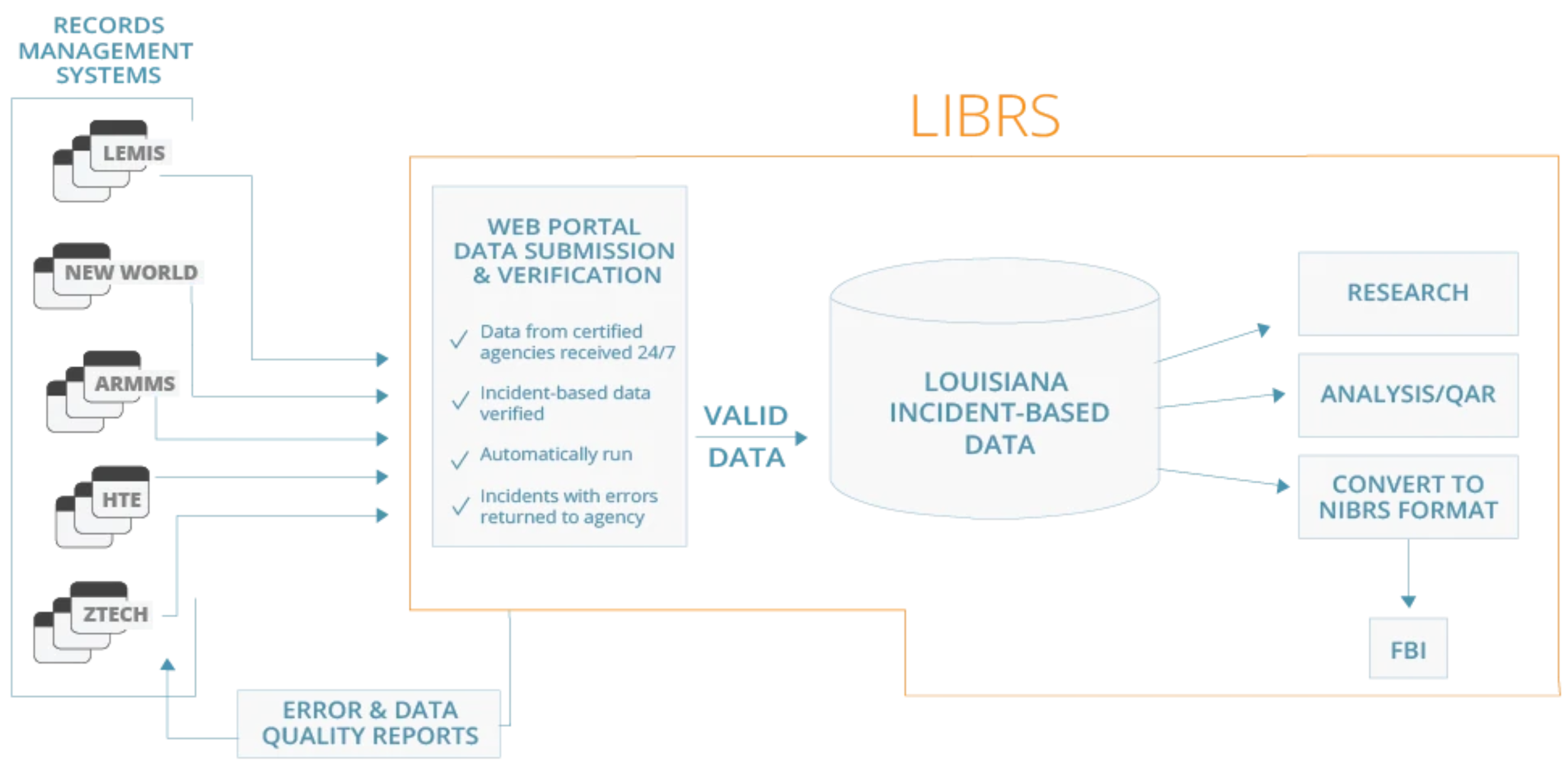
Every month, NOPD forwards a subset of their “Calls for Service” dataset to the FBI’s Uniform Crime Reporting (UCR) program, which historically focused on 10 specific violent and property “index” crimes. The program recently shifted to the National Incident-Based Reporting System (NIBRS)—a subset of which (LIBRS) NOPD compiles using Mark43 software internally—which tracks many more incident details, such as the context, multiple offenses, demographics and victim-offender relationships.
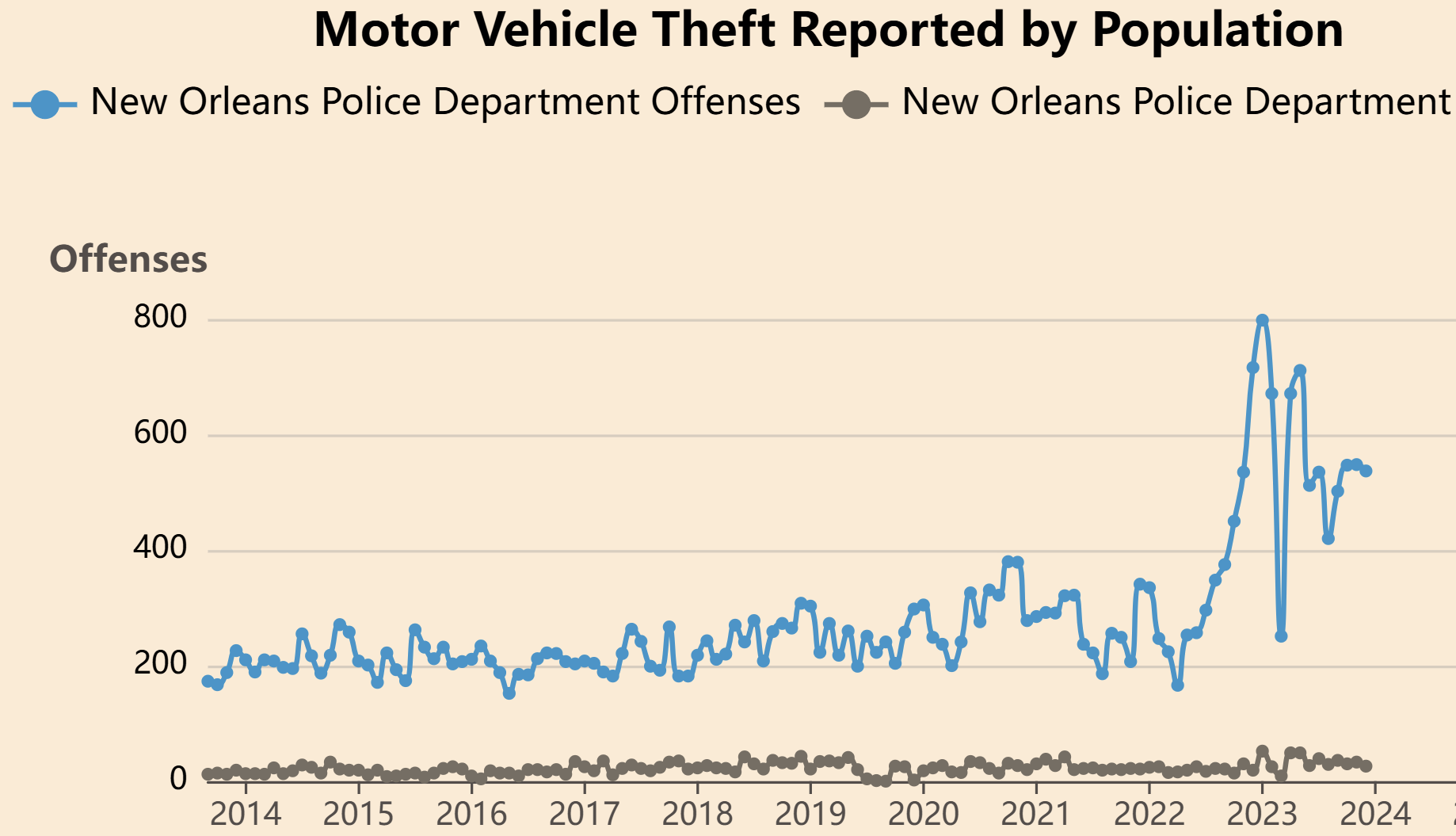
Data Tools: FBI Crime Data Explorer
Sample graph showing incidents (blue) of Motor Vehicle Theft reported by NOPD between 2014 and 2024, along with case clearance rates (grey)
Another data repository is the FBI’s Crime Data Explorer that allows researchers access to comprehensive crime data reported by law enforcement agencies from every state, ultimately shaping federal funding and national crime trends, tracked at the highest level by the Bureau of Justice Statistics. The National Archive of Criminal Justice Data (NACJD) also warehouses a wide range of historical datasets for policymakers, researchers and students to consult.
At the municipal level, I encourage you to attend Criminal Justice Committee meetings, where NOPD leadership appears before the City Council each month to present formal progress reviews and answer for the department’s performance. The Council maintains its own public safety dashboard on the web, offering you a multi-agency snapshot of the entire criminal justice system.
Department Structure and Command
By familiarizing yourself with NOPD’s organizational chart, you gain an understanding of the department’s overall top-down structure, starting with the Superintendent’s Office presiding over a handful of bureaus, under which fall many smaller operational divisions, offices, sections, units, and teams. Someone working in the Digital Forensics Unit, for example, is assigned to the Property Crimes Section within the Special Investigations Division, a component of NOPD’s Investigation and Support Bureau.
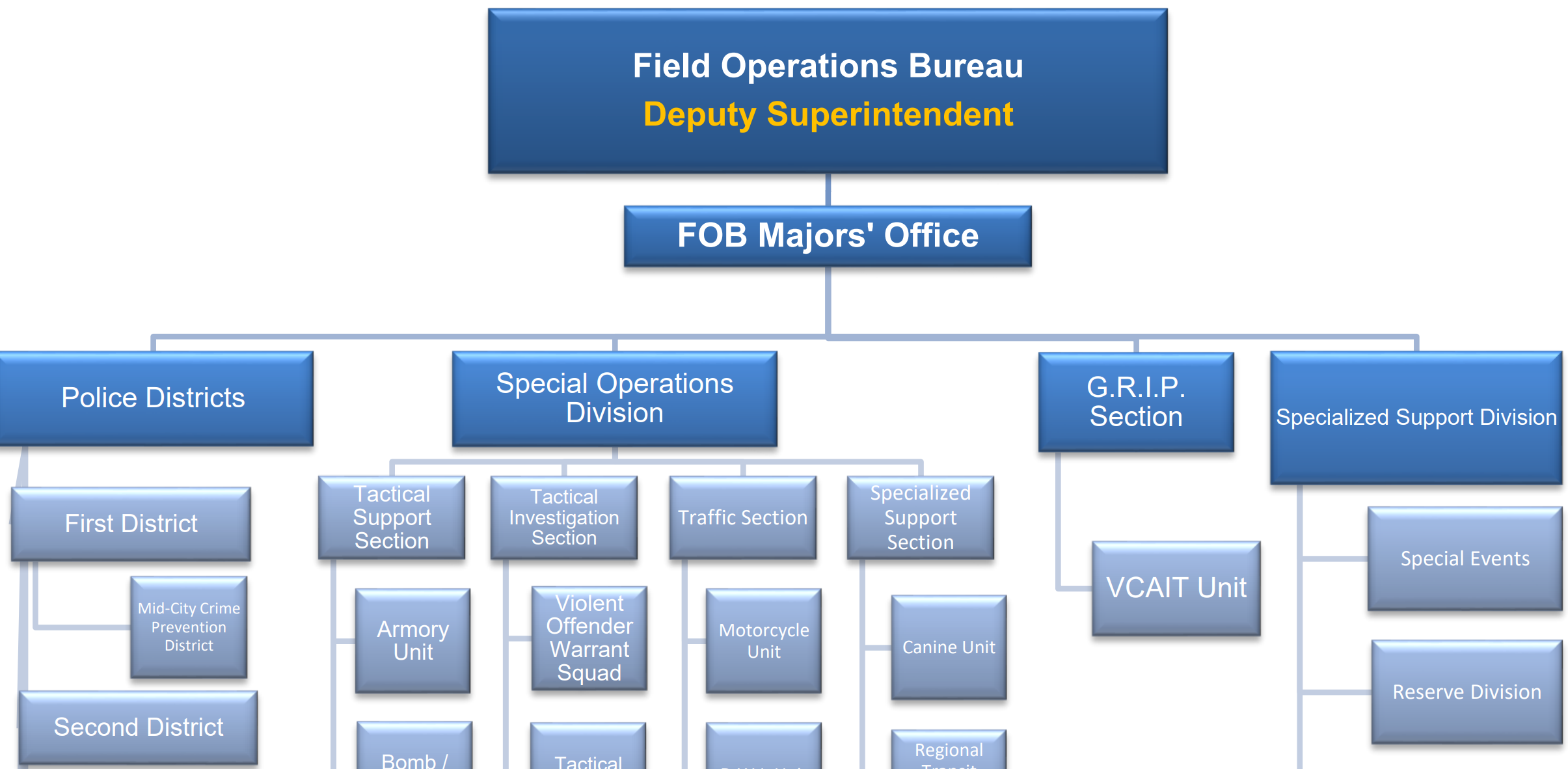
Portion of the NOPD org chart showing elements of the Field Operations Bureau
NOPD’s command structure follows a similar hierarchy, with the Superintendent, who serves at the pleasure of the Mayor, at the very top. Down the chain of command you will find subordinate officers including Majors, Captains, Lieutenants, Sergeants and lastly four grades of Police Officer, with Detectives and other personnel rounding out the roster. Learning how to spot an officer’s rank and/or assignment, by reading the symbols on their shoulder, lapel or badge, is not only empowering, but a welcome show of respect.
Raising the Bar
Captain wearing a white shirt, double gold bars and badge number 57, lined up next to a Lieutenant wearing a blue shirt and single bar on each epaulet. Behind them stands a Police Officer with lapel number 3, signifying assignment to Third District station.
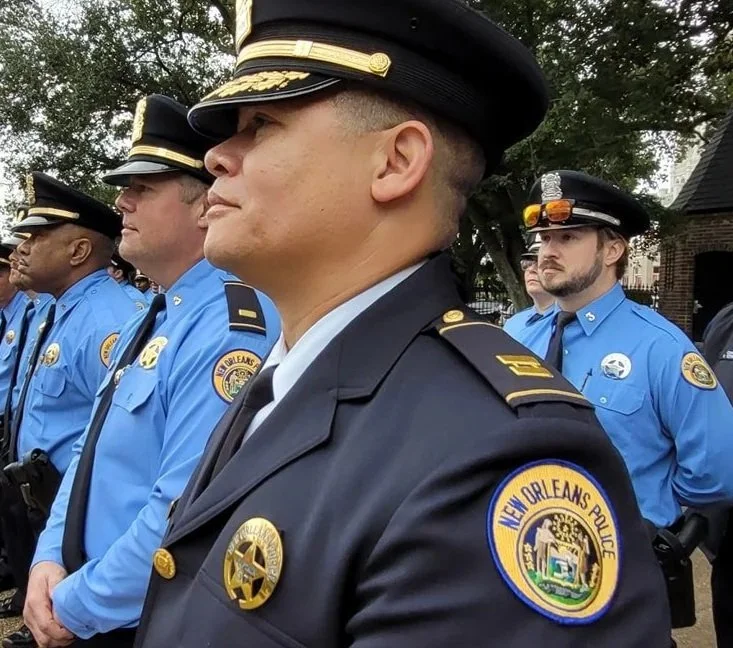
Every step up in rank brings not only seniority and higher pay; it also demands extensive training, education and proficiency, matched with expanded supervisory responsibility. For example, each major bureau has a ranking Deputy Chief assigned, while the eight police districts are led by Captains (formerly Commanders with rank similar to Major), and on down the line in classic paramilitary fashion, with Majors or Captains overseeing divisions, Lieutenants managing stations, Sergeants leading platoons, and so on.
In early 2026, there were around 900 commissioned officers at NOPD. As classified members of the City Civil Service, most NOPD staff enjoy merit-based hiring and promotions, along with other important job protections. Notable exceptions include top leadership and administrative personnel, who tend to occupy unclassified “at-will” positions, as do most civilian roles.
Because we are the eyes and ears of the community, NOPD grasps the importance of gaining our perspective, whether at home, on the street, during recreation, at work or in school. In fact, outreach has become such a vital component of today’s police work that NOPD hosts a slew of community engagement programs, and embeds specialized officers within each district to meet people across many settings:
Community Liaison Officers (CLO) build trust at the neighborhood level; facilitate communications; manage quality of life issues throughout the district; analyze community feedback; and, formulate a prioritized problem-solving action plan for their Captains;
Officer Friendly program teaches youth basic crime prevention and self-protection techniques; builds a positive and lifelong relationship with law enforcement;
D.A.R.E. officers teach schoolchildren how to resist peer pressure and live productive, drug- and violence-free lives;
Junior Citizens Police Academy lets young people explore the world of law enforcement through hands-on experiences;
Police Activity/Athletic League (PAL) and Summer Basketball League build community through direct interaction with off-duty officers in a structured yet informal recreational setting;
School Resource Officers (SRO) are informal counselors who build relationships among students, their families, and school staff to reinforce positive behavior both on campus and at home;
The Victim/Witness Assistance Program explains applicable laws, rights and resources available for victims and witnesses of felony crimes against persons;
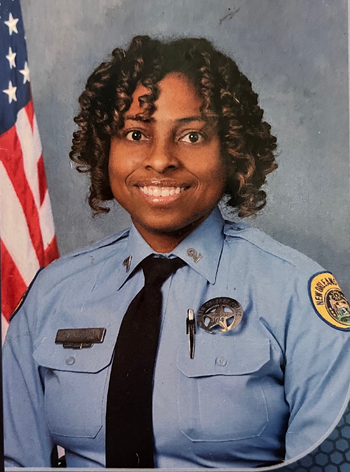
Volunteer Citizen Ambassadors create meaningful connections between police officers and residents, working side by side to enhance safety and understanding in our neighborhoods;
Designated liaisons serve specific populations—homeless, LGBTQ+, Vietnamese, and Spanish-speaking communities—who might otherwise be vulnerable, underserved or marginalized.
District School Resource Officer
Tiwana Conway
Second District
Support and Community
NOPD serves our community in countless ways, yet they cannot do it all alone. Become a force multiplier by exploring ways to support officers directly, such as the non-profit New Orleans Police and Justice Foundation (NOPJF), who assist with recruiting efforts and provide officer assistance. Certain districts are sponsored by C.O.P.S. organizations, who furnish some of the quality of life essentials—like station repairs, bullet-proof vests and other field equipment, or hot meals during Mardi Gras duty—that often fall through the cracks of the city budget.

CrimeStoppers of Greater New Orleans
Some of the many local organizations supporting the mission of NOPD and other law-enforcement agencies.
ProjectNOLA
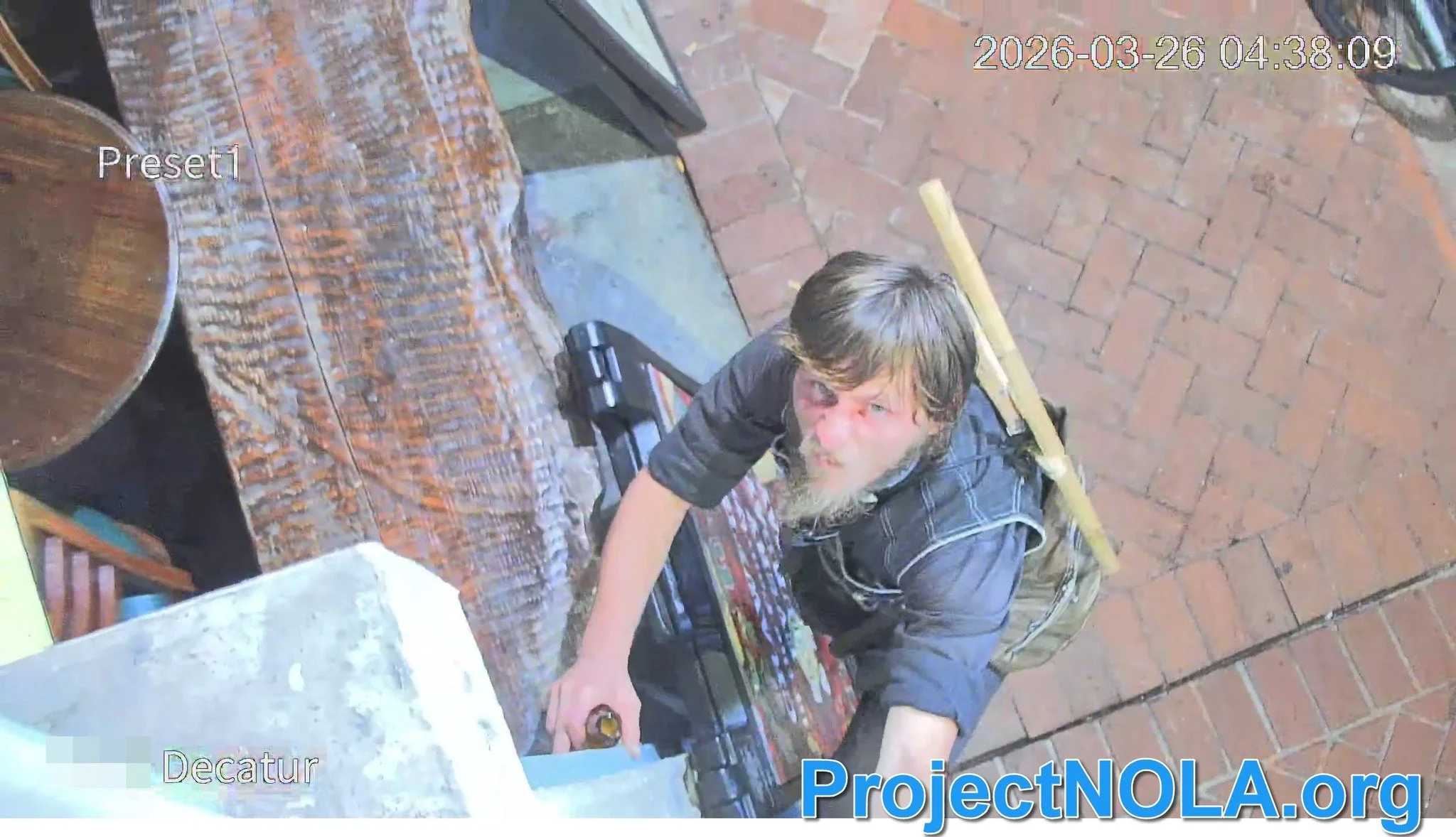
On the technology and investigative side, the independent non-profit ProjectNOLA operates a city-wide crime camera network that provides critical time-sensitive leads to detectives, while Crimestoppers GNO solicits anonymous tips, offers cash rewards for vital information, and honors exemplary service in the field through Officer of the Year awards.
Citizens just like you don’t need a badge to make a difference. Every donation you make, camera you host, or tip you submit helps NOPD perform its job more effectively and efficiently. But law enforcement is only one branch of the broader justice system; there are plenty of other opportunities for you to contribute, whether it’s a small donation or a few hours of your time.
Spending a morning with Court Watch NOLA, for example, is an eye-opening way for volunteers to ensure integrity and transparency in our courtrooms. The Pro Bono Project welcomes attorneys, paralegals, law students, and private citizens willing to render services free of charge to clients who otherwise lack access to the legal help they need. You might also consider volunteering for jury duty—or more importantly serve when summoned—as this is perhaps the most fundamental way to keep the wheels of justice turning.
Operations and Protocol
Daily life at the NOPD is driven by the platoon system, where uniformed patrol officers work rotating 8- or 12-hour shifts—known as the “Morning”, “Day” and “Night” watches—to ensure round-the-clock coverage. During the start-of-shift roll call, supervisors brief their teams on active warrants, recent crime trends, and any special assignments for the day. While routine patrol is the bread and butter of the force, you will sometimes observe the NOPD engaging in joint operations with the Louisiana State Police and/or various federal agencies for high-visibility details like Mardi Gras or Super Bowl.

The Public Integrity Bureau (PIB), headed by a civilian Deputy Superintendent, proactively measures and enforces police performance standards and investigates allegations of misconduct. To avoid conflicts of interest, officers seeking employment outside the department must coordinate with the Office of Police Secondary Employment (OPSE), which sets hiring terms and handles payroll, allowing no more than 24 hours of paid details during a given week. Recently tightened restrictions also apply to working overtime.
Such strict departmental policies are intended to align with established Louisiana state law, and conform with the recently completed federal consent decree, mandating dozens of foundational reforms to be undertaken by the Professional Standards & Accountability Bureau (PSAB). Added external oversight is provided by the Office of the Independent Police Monitor (OIPM), a civilian-led entity tasked with improving police service to the community while boosting citizens’ trust in the NOPD.
Facilities and Task Forces
The NOPD operates out of eight district stations, each serving as the nerve center for local neighborhood policing. Know the location of your nearest station and feel free to visit with them questions or concerns, or to attend your district’s weekly community meetings. Less visible but supporting every district nonetheless are specialized units trained for high-stakes operations: SWAT teams, the K-9 Unit, Marine Search & Rescue, and Bomb Disposal, to name a few. One such unit, the Mounted Unit, hosts an annual Horses, Hops & Cops fundraiser, and invites you to sponsor a horse through their Adopt-A-Horse program, or make a donation directly through NOPJF.
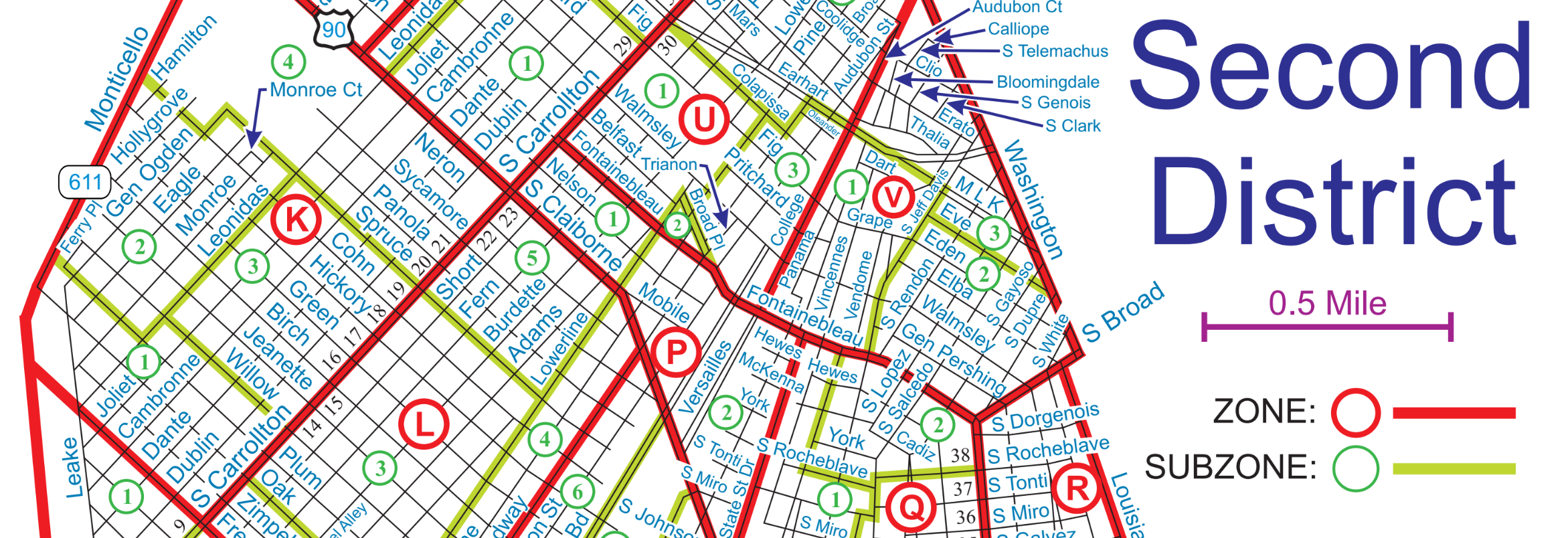
Districts: Know Your Zone
NOPD divides the city map into eight districts, each subdivided into lettered zones and numbered subzones, as illustrated here in Second District.
Operations are assisted by the Real-Time Crime Center (RTCC), a 24/7 central command center that proactively monitors locations across the city using advanced technology, such as license plate readers, fixed and mobile cameras, and increasingly, airborne drones. Recently added to the detection arsenal is ShotSpotter, an acoustic surveillance system that detects the sound of gunfire and alerts dispatchers within seconds—often before a single 911 call is placed. These tools collectively allow the department to "arrive" at a scene virtually before officers physically reach the location, providing real-time intelligence on suspect descriptions, getaway vehicles, and last known heading.
You, too, can participate in this evidence-gathering network by registering your home or business security cameras with SafeCam NOLA. Registration doesn't give the police live access to your feed; it simply lets them know where cameras are located so they can request footage if a crime occurs nearby. This resource expedites investigations, aids in prosecution, and empowers residents to partner with NOPD in the fight for a safer city.
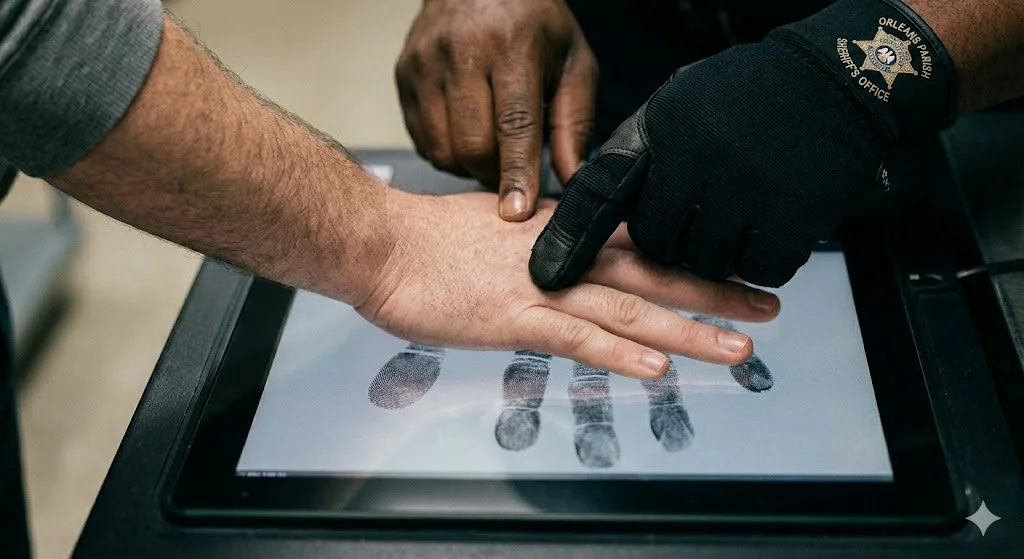
Orleans Parish Sheriff
OPSO is responsible for intake and processing of arrested persons placed in custody by NOPD
Following an arrest, suspects are transported under guard to the "intake" or booking area of Orleans Justice Center (OJC), the city's primary detention facility managed by the Orleans Parish Sheriff’s Office (OPSO), where the process begins of fingerprinting, photographing (mugshots), medical screening, and taking inventory of personal property. It is there that NOPD officially hands over physical custody of the suspect to the Sheriff, to await a bond hearing or initial appearance before a judge.
If you are looking for information on someone recently imprisoned, you can use the OPSO Inmate Lookup tool. It provides public information on current detainees, including their booking photo and the specific charges they are facing. The status of cases and trial dockets can later be ascertained using the Criminal District Court (CDC) website, especially helpful if you wish to attend or happen to be called as a witness or friend of the court.
Training and Education
Before an officer ever hits the street solo, they must endure the rigorous 26-week program of classroom instruction conducted by NOPD Training Academy, including physical conditioning, and scenario-based training. The ultimate goal of the academy is to produce a P.O.S.T. Certified officer, a state-mandated certification that grants an individual legal arrest powers. To earn it, a cadet must complete nearly 500 hours of core curriculum—covering everything from constitutional law and firearms proficiency to de-escalation and crisis intervention—and pass a high-stakes statewide exam.
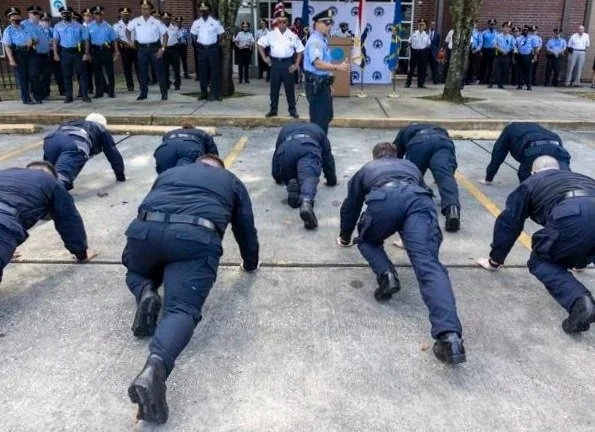
After completing the Academy, rookies enter a 16-week Field Training Officer (FTO) program, where they are mentored by veteran officers in real-world scenarios. As their careers progress, officers can seek specialized certifications that serve as force multipliers for the department. One of the most critical of these is the Crisis Intervention Team (CIT) certification, which trains officers to safely handle mental health emergencies, and interfaces with organizations like NAMI New Orleans to promote awareness.
Other paths for advancement include becoming a Detective within the Investigations Bureau or joining elite units like the Violent Offender Warrant Squad (VOWS). As a means of supplementing manpower, particularly in the lead-up to major events and festivals, NOPD periodically conducts a Reserve Police Academy, a 7-month course offering candidates (including adult civilians) three distinct levels of training.
Citizens Police Academy
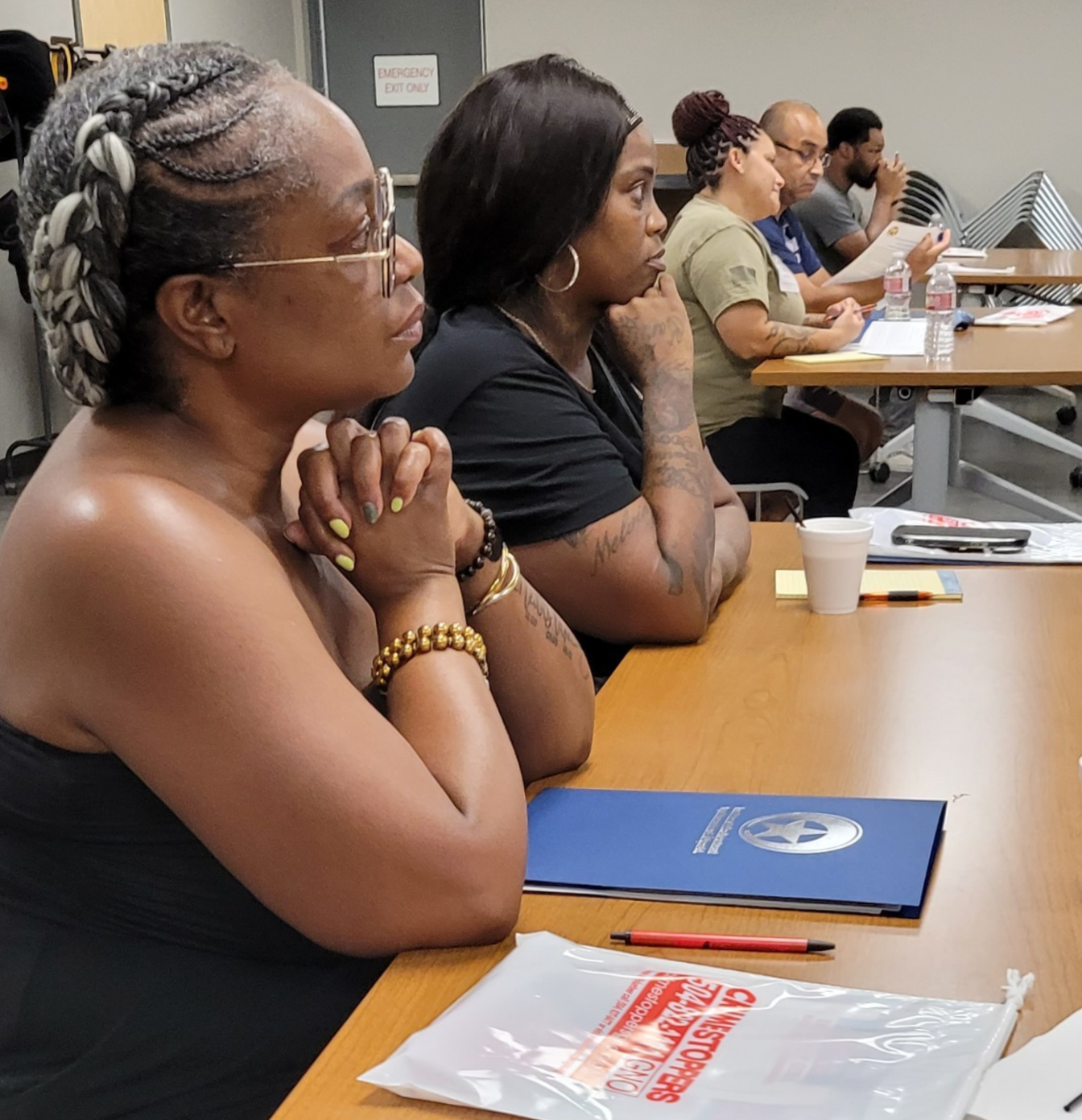
Command staff welcome another classroom of participants eager for firsthand insight into modern policing
For those who aren't looking for a career change but still want a look behind the curtain, the NOPD offers the Citizen’s Police Academy. This free course includes presentations from leaders in the law enforcement community, showcasing the complexities of modern police work, including community policing strategies, patrol operations, and specialized division activities. The weekly classes let you experience abbreviated versions of cadet training, including the driving track and firearms simulators.
For the ultimate in first-hand community policing, you can even request a ride-along through your local district station; it’s an eye-opening way to witness an officer’s challenging decision-making process—from prioritizing a 911 dispatch call to documenting evidence at a scene.
Neighborhoods and Advocacy
At the neighborhood level, celebrate the annual Night Out Against Crime by hosting a block party, or joining with neighboring communities as a show of solidarity. This is an ideal opportunity to invite officers from your district, along with other public servants, to show appreciation for what they do throughout the year. Event planners can submit a request with NOPD to erect temporary barricades to divert traffic, and OPSO offers a free tent rental (including setup and knockdown) in anticipation of inclement weather.
Invite your community-minded friends to consider signing up for Civic Leadership Academy, Red Cross CPR Training, or any of the other free citizens’ academies and workshops offered locally. For those looking to take a deeper dive into neighborhood engagement, there are a dozen City-sponsored programs tailored to interests ranging from resource fairs and litter abatement, to youth empowerment and faith-based initiatives.
Junior Civic Leadership Academy
Empowering youth on their
civic leadership journey

Neighborhood advocates likewise have a duty to promote compliance with the law, whether it be parking rules, animal ordinances, health regulations, property maintenance or otherwise. By gently urging neighbors to embrace such basic civic duties as registering their bicycles, disposing of trash properly, enrolling rentals in the Healthy Homes Program, renewing annual burglar alarm permits, adopting a catch basin (storm drain), reporting flooded conditions to StreetWise NOLA, or instances of illegal dumping to 311, one automatically improves the quality of life and general welfare of our citizenry. These simple measures, by contributing to a well-functioning society, also help our police department in meaningful ways.
Finally, remember that your direct feedback is a powerful tool for departmental accountability. If you encounter an officer who goes above and beyond—or, conversely, one whose conduct fails to meet professional standards—you can submit a commendation or complaint online. These forms are more than mere paperwork; they become part of an officer’s permanent record and can directly influence their career trajectory, affecting everything from promotion eligibility to internal disciplinary actions. By taking a moment to document your experience, you ensure that exemplary service is rewarded and that the department remains answerable to the community it serves.