
The Life and Times of Pierre Marly (1793–1839)
Illustrious journey of a neighborhood namesake
PART I: Creole Lineage—”Le pére de mon pére”
To understand the origins of Marlyville subdivision, one must examine the milieu into which its founder and namesake, Pierre Marly, was born. Third- and fourth-generation New Orleanians of the late 18th century came along at a time when the city was transitioning from Spanish control back to the French. The recently hoisted flag of the United States, though widely known and highly regarded, was not yet ours; Louisiana’s hard-won statehood lay just over the horizon.
-
1790s
Spanish colonial rule
Reconstruction following Great Fires of 1788 & 1794 included building code reforms, replacing wood construction with brick and stucco
Elite French planters and free people of color escaping Haiti bring heightened political awareness
Population 5,300: 45% white, 15% free people of color, 40% enslaved
1800s
Retroceded French rule
Carondelet Canal connects the Tremé to Bayou St. John
‘Right of Deposit’ transforms city to global trade hub overnight
Population 8,000: 50% white, 17% free people of color, 43% enslaved
1810s
United State rule over Orleans Territory
The Louisiana Purchase anchors city as the gateway to a new frontier
Massive influx of refugees from Haiti and Cuba
Population 17.300: 37% white, 28% free people of color, 35% enslaved
A native-born Creole like Marly received the customary education as a polyglotte trilingue in childhood, speaking all three local dialects fluently: standard French of the ruling aristocracy; the lingering Spanish of the colonial legal system; and the emerging English of the new American economy. La Nouvelle Orléans—a diverse, inhospitable frontier town of ten thousand, doubling every decade—stood perched at the vanguard of domestic and international commerce, exposing adolescent Pierre to all manner of customs and curiosities.
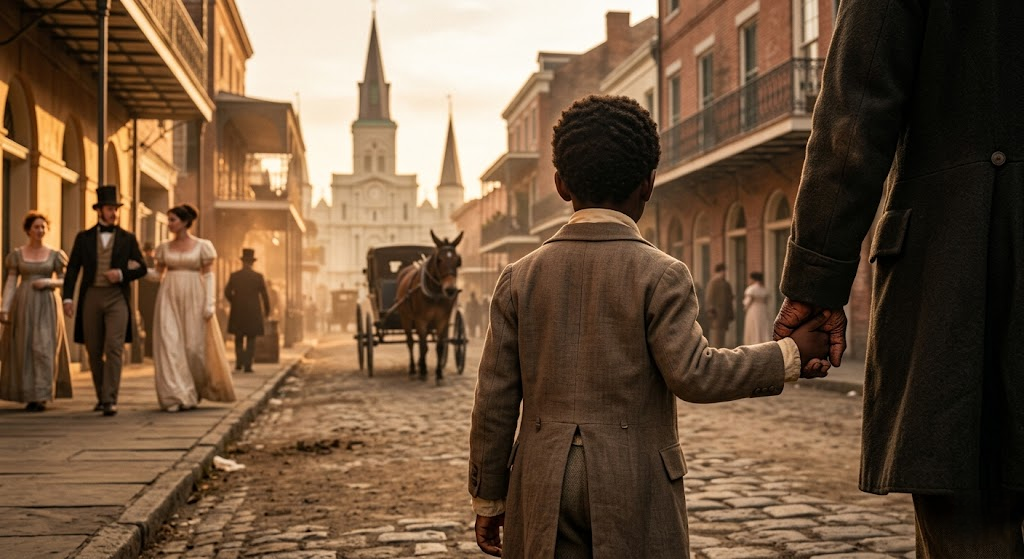
Pierre and his father Monsieur Marly en route to Sunday mass, circa 1800
Marly’s paternal lineage, as privileged Gens de Couleur Libres, bestowed upon him the freedom to move among the strata of New Orleans society. Having never suffered abject enslavement the way his own mother had, yet far from entitled, Pierre grew up the very definition of middle class. His family always took pains to ensure the liberty of those in their inner circle: sometimes cosigning or covering the costs of manumission, at other times granting shares in property, or solemnizing domestic unions to bolster community standing. The Marlys stuck together.
This theme of self-determination meshed perfectly with a lifelong religious foundation that first coalesced for the young boy standing in the shadow of the Cathédrale Saint-Louis. At age 16, while attending his godchild’s baptism, Pierre witnessed firsthand the ceremonial act consecrating an infant’s bond with his community. The école gratuite, offering a curriculum of equal parts academics and catechism, stressed the Catholic faith’s abiding respect for tradition, rectitude of spirit, and steadfast devotion to family, ideals that later defined Marly the man.
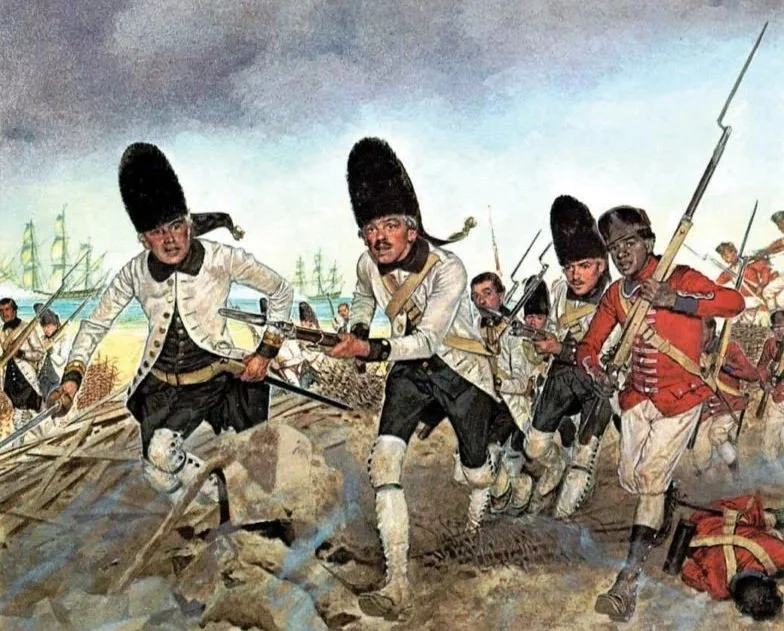
Grenadiers and militiamen in battle during the Gulf Coast campaigns (1736)
The second son of a soldier, whose forebears fought honorably alongside city founder Jean-Baptiste Le Moyne de Bienville during the Mobile Wars—his great-grandfather, Jean Baptiste Marly was killed in 1739 fighting the Chickasaw at Fort de l'Assomption—Pierre’s character naturally gravitated toward honor, obedience and above all, discipline. Literacy, wisdom and wile may be admirable traits, but only discipline could guarantee the welfare of his kin, in an age when a reputable family name and a respectable inheritance were considered paramount.
That same discipline would again pay dividends when 21-year old Pierre patriotically answered the call of duty during L'Invasion Anglaise.
