
The Life and Times of Pierre Marly (1793–1839)
Illustrious journey of a neighborhood namesake
PART II: Military Metamorphosis—The War of 1812
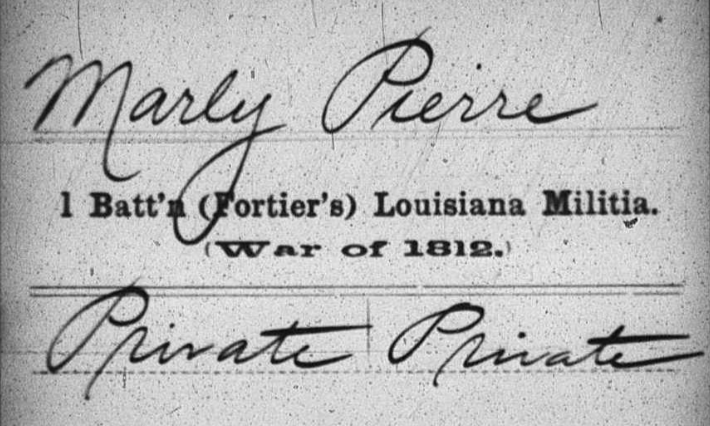
In 1812, shortly after Marly reached majority, Louisiana became the first state in the nation to authorize a volunteer militia of free Black men. Motivated either by civic pride or a youthful wave of patriotism—perhaps spurred by the need to supplement his recently widowed father’s income—Pierre immediately enlisted. Like hundreds of his contemporary artisans, mechanics and tradesmen who joined up that year, Pierre had memorized the military drills performed in Place d’Armes (now Jackson Square) every Sunday after mass; he would make a fine Army private.
Commanded by Creole merchant Michel Fortier II, the First Battalion of Free Men of Color—many of them fellow francophones with substantial land interests of their own to protect—eagerly fought alongside Federal troops. Entrenched along the cold and muddy ramparts of Chalmette battlefield, they dispatched the English invaders in short order, Marly’s outfit suffering barely a dozen casualties in an hours-long skirmish that left two thousand British dead on the field. The war suddenly ended, the retreating enemy vanquished. New Orleans and environs remained safely in American hands.
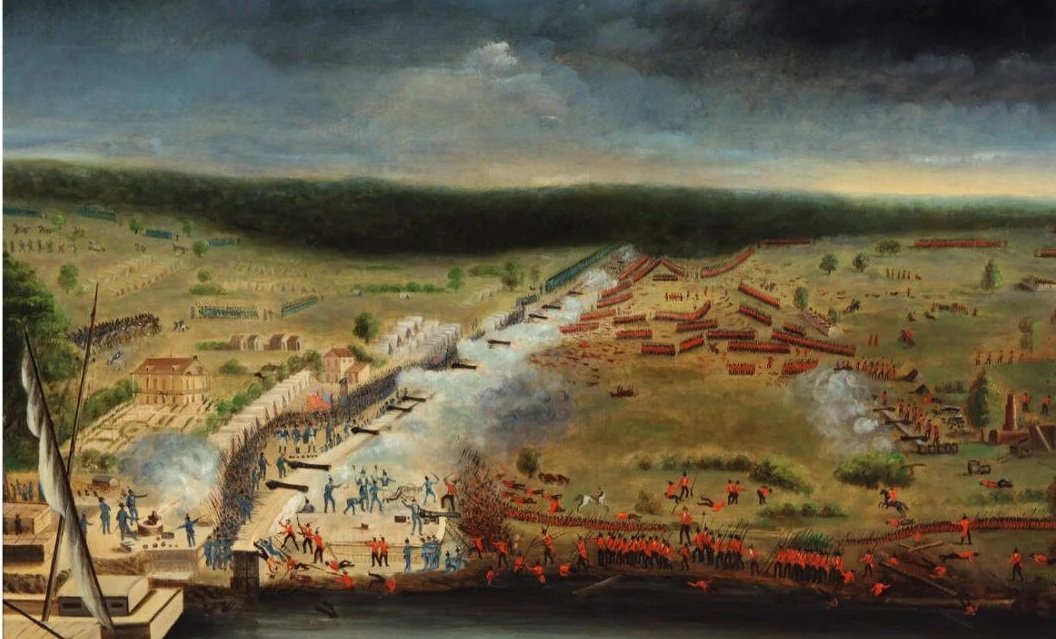
Battalion of Gens de Couleur Libres (blue uniforms) fighting at the Battle of Chalmette (1815)
Pierre Marly, and United States Army veterans like him who had answered General Andrew Jackson’s call to arms, earned a country’s accolades for such a swift and decisive victory. The bravery these patriotic men showed fighting for Louisiana commanded adulation from Governor Claiborne, and colorful nationwide accounts of their valor made instant heroes of some, such as the industrious privateers Jean and Pierre Laffite, whom Marly had known and admired since childhood.
Creole Connections
Michel Fortier, a high-ranking militia officer, led the largely Creole 1st Battalion to victory in 1815.
Fortier’s rural Esplanade ridge plantation formed the backbone of one of the city’s most prestigious Creole residential corridors. Another was later subdivided as part of the Town of Carrollton.
The returning soldiers also enjoyed the eternal gratitude of the region’s more established land barons—Derbigny, Gravier, Foucher, Doliolle, Marigny, Hazeur, LeBreton, Avart, Bouligny, Pontalba, Macarty—for sparing their families’ almost certain ruin. Following an honorable discharge in 1815, Marly likely sought their advice on how best to invest his sizable windfall, as the wages and bounties Congress granted to enlistees had been rather generous. Soon enough, one particularly grand speculative opportunity would arise for Pierre, who in the meantime pursued civilian life as a bricklayer’s apprentice.
Without doubt, Marly’s identity derived in part from a century of colonial survival, dating back to when the Milice d'Assemblée—a militia of free men of color who helped Gobernador Gálvez to seize Mobile—tenaciously defended the backbone of the Gulf Coast. Just as his father and his father’s father never saw themselves as subjects, but as stakeholders in the future of territorial New Orleans, so too would Pierre proudly identify himself as a builder, a protector, a planner.
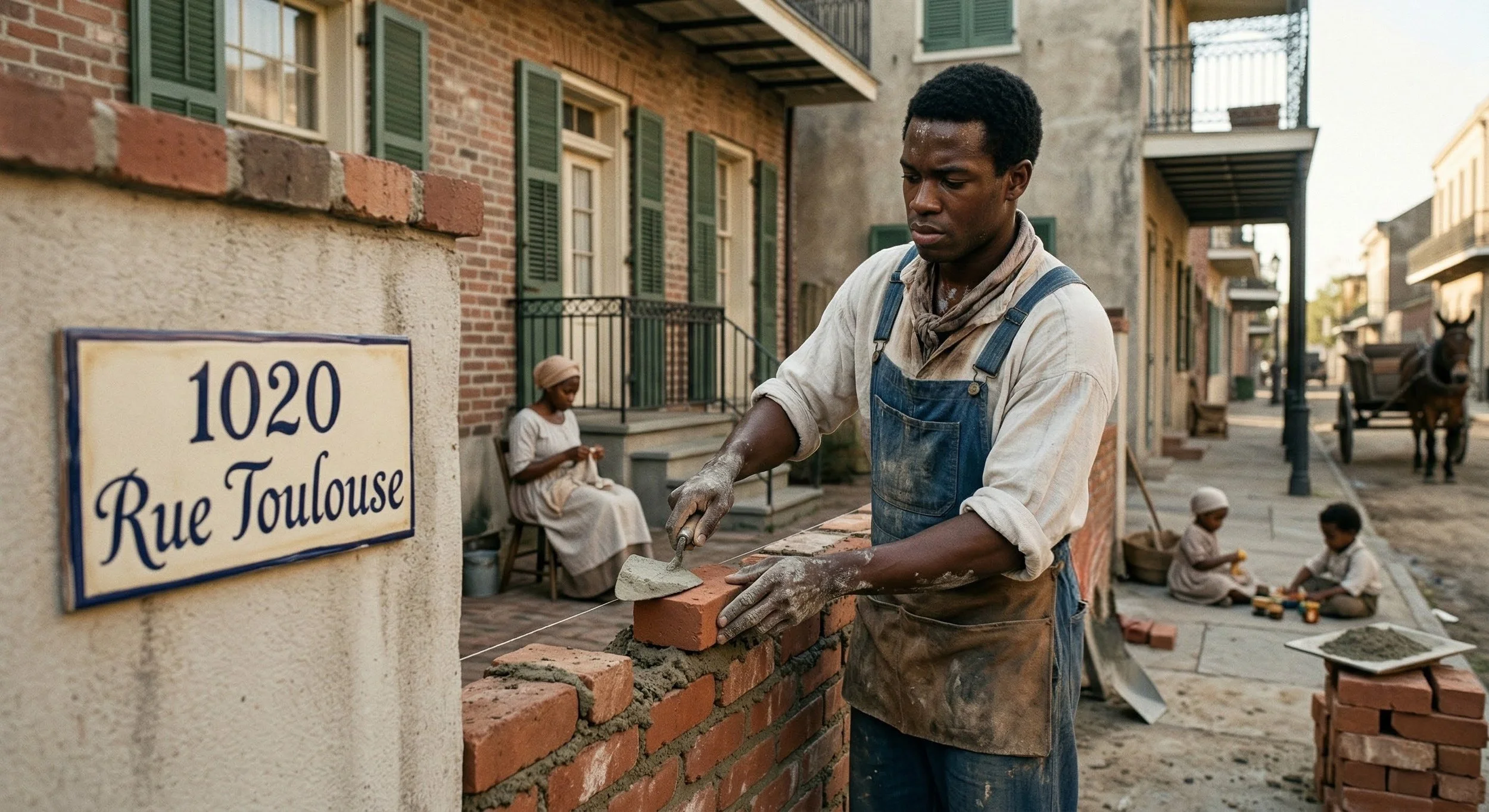
Pierre Marly owned several French Quarter properties, including this modest residence at 1020 Toulouse Street
The venerable trade of maçon provided Marly more than a mere livelihood; it forged a path to significant wealth-building. The Great Fires of 1788 and 1794 had consumed broad swaths of the city almost entirely unchecked. Officials now demanded far stricter building codes, emphasizing fireproof brick and stucco construction over timber. New Orleans’ protracted reconstruction efforts required many skilled hands, benefiting Pierre’s professional career tremendously, and virtually guaranteeing his success as an aspiring speculator and land developer.
By mid-life, Pierre had evolved from journeyman to craftsman to landlord—his name appearing on deeds to several Vieux Carré properties, some of them inherited from his father, who passed in 1810—and taken up residence in the adjoining Faubourg Marigny. The seeds to future prosperity thus having been sown, Marly’s long-term plan was steadily taking root and would soon bear fruit.
Nearly forty, it was time for Marly to wed and begin building a family of his own.
